


Hammer mills

Hammer mills for efficient grain, straw and wood processing
Hammer mills provide an efficient way to reduce grain, straw, alfalfa, wood chips and similar raw materials to a more consistent particle size. Whether you are preparing ingredients for animal feed or processing biomass before pellet production, the right hammer mill can save considerable time compared with manual preparation while providing much more repeatable results.
At expondo, you can choose Wiesenfield hammer mills designed for different production volumes, from compact equipment for smaller farms and workshops to a powerful industrial hammer mill capable of processing well over a tonne of material per hour under suitable conditions. The available models range from 2.2 to 22 kW, with stated production capacities extending from 30–120 kg/h at the entry level to 800–1,800 kg/h for the highest-capacity machine.
This makes it easier to select a hammer mill machine according to the amount of material you actually need to process rather than buying equipment that is unnecessarily large or too slow for your workload.
Which hammer mill machine is right for your workload?
The main difference between the hammer mills in the expondo range is their combination of motor power and hourly output.
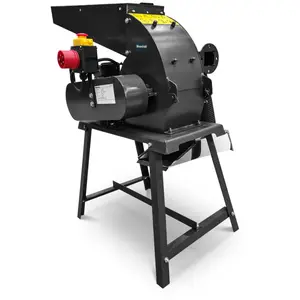
The compact 2.2 kW model is designed for approximately 30–120 kg/h and uses 12 hammers operating at around 2,986 rpm. It is a practical option when processing relatively modest quantities of grain, straw, alfalfa or wood chips. Three supplied sieves with 3, 4 and 7 mm perforations give you useful flexibility over the size of the processed material.
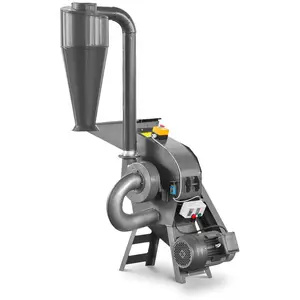
For higher-volume work, the 4 kW hammer mill offers a stated capacity of 200–300 kg/h. It uses 16 hammers, runs at approximately 2,800 rpm and is supplied with 4 and 6 mm sieves. A cyclone provides controlled discharge of the milled material, making the machine suitable for more regular processing.
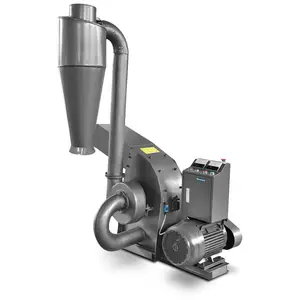
The 11 kW model increases capacity to approximately 300–700 kg/h. Its 16-hammer system operates at around 2,982 rpm, while the larger 680 x 280 mm sieve area and supplied 4 and 6 mm screens support substantial agricultural and biomass-processing workloads.
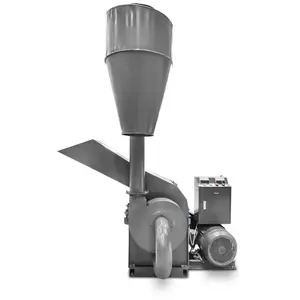
For demanding production, the 22 kW industrial hammer mill reaches a stated output of approximately 800–1,800 kg/h depending on the raw material and its moisture content. It combines 24 hammers with an operating speed of around 2,982 rpm and a cyclone discharge system. This is the option to consider when processing large quantities is a regular part of your operation.
Actual output depends on the material being processed, so nominal capacity should always be considered alongside moisture, density and feed characteristics.
How does a hammer mill work?
A hammer mill crusher reduces material mainly through repeated high-speed impacts. Material enters the machine through the feed opening and is struck by rapidly moving hammers. The resulting centrifugal force moves the particles towards the surrounding sieve, where only material small enough to pass through the perforations can leave the milling chamber.
This principle provides two important benefits. First, the high-speed hammer action makes it possible to process fibrous or relatively bulky agricultural materials quickly. Second, the sieve gives you considerably more control over the final particle size than uncontrolled crushing.
Screen selection is therefore an important part of choosing and operating a hammer mill. Smaller perforations produce finer material, while larger openings allow coarser particles to leave the chamber more quickly. The expondo range includes machines with 3, 4, 6 or 7 mm supplied sieve options depending on the model.
A consistent particle size can make subsequent mixing, feeding or pellet pressing considerably easier because the material behaves more predictably during the next stage of production.
Grain hammer mills for feed and agricultural processing
A grain hammer mill can be especially useful for farms, livestock operations and agricultural businesses that prefer to prepare their own feed ingredients. Grain can be broken down into smaller particles, while materials such as straw and alfalfa can also be processed when they are suitable for the machine.
If your main objective is specifically processing cereals into different milled products, it is also worth comparing expondo's grain mills to determine which type of milling equipment best matches your required result.
Hammer mills are particularly useful when you want one machine capable of dealing with several suitable agricultural or biomass materials rather than focusing only on one type of grain. Alongside other professional agricultural equipment, they can form an important part of an efficient feed or biomass preparation setup.
Preparing raw material for pellet production
One of the most important applications for the Wiesenfield hammer mills offered by expondo is preparing material before pellet pressing.
Producing strong, consistent pellets requires reasonably uniform feedstock. Pieces that are excessively large or inconsistent can make further processing more difficult. A hammer mill reduces grain, straw, alfalfa or wood material before it reaches the pellet press, helping create a more manageable raw material.
After milling, appropriately prepared material can be processed further with pellet machines to manufacture feed pellets or suitable biomass pellets. Choosing the correct sieve in the hammer mill allows you to adapt the preparation stage to the material and the requirements of your downstream equipment.
Material condition matters as well. The Wiesenfield machines in this category specify a moisture-content tolerance of approximately 8–15%. For dependable performance, check that your raw material falls within the requirements of the individual model before milling. Material that is too damp can be more difficult to process effectively and may reduce achievable throughput.
What should you consider before buying an industrial hammer mill?
Start with capacity. A machine capable of 30–120 kg/h may be perfectly adequate for occasional or smaller-scale processing, whereas an operation handling several hundred kilograms per hour requires significantly greater motor power and throughput. If your production requirements may increase, consider whether extra capacity would prevent the mill becoming a bottleneck later.
Next, consider the required particle size. The supplied sieve sizes differ between models. The 2.2 kW hammer mill includes 3, 4 and 7 mm screens, while the 4, 11 and 22 kW models are supplied with 4 and 6 mm screens. Select a machine whose available sieves suit the material you want to produce.
Power supply is another essential consideration. The hammer mills in the current expondo range use a three-phase 380 V supply, so you should confirm that an appropriate electrical connection is available at the intended installation point.
Machine size and weight also increase substantially with capacity. The smallest model measures approximately 59 x 55 x 90 cm and weighs 58 kg, while the 22 kW version measures around 160 x 90 x 222 cm and weighs approximately 472.5 kg. Check access, installation space and the suitability of the floor or base before choosing a larger machine.
Finally, think about how material will leave the machine. The compact 2.2 kW model uses a controlled side discharge, while the 4, 11 and 22 kW models incorporate a cyclone as part of the supplied setup. For frequent processing, an organised discharge system can help you manage milled material more efficiently.
Hammer mill, hammer mill shredder or crusher – what is the difference?
Terms such as hammer mill shredder, hammer crusher and hammer mill are sometimes used loosely, but the machines do not always perform the same job.
Conventional shredders generally focus on coarse size reduction, often using comparatively slow cutting or tearing mechanisms. Hammer mills use much faster impact action and a sizing screen to produce smaller, more consistent particles. A hammer mill crusher is therefore more appropriate when the goal is not simply to make material smaller, but to achieve a controlled size suitable for a subsequent production stage.
For the Wiesenfield models available from expondo, the main applications are agricultural materials and biomass such as grain, straw, alfalfa and wood chips. They should therefore be selected according to these intended uses rather than treated as general-purpose machines for crushing unrestricted materials.
Robust hammer mills for regular processing
Regular agricultural and biomass processing places significant demands on machinery. The Wiesenfield hammer mills use robust carbon-steel construction combined with iron or cast-iron components, depending on the model. Stable bases or work tables support controlled operation, while dedicated feed openings and discharge arrangements help keep material moving through the process.
Maintenance remains important with any industrial hammer mill. Hammers and screens are working components and should be inspected for wear, while the milling chamber should be kept clean in accordance with the operating instructions. Correct feeding is equally important: supplying material evenly rather than overloading the chamber helps maintain consistent milling and reduces unnecessary stress on the machine.
Always follow the instructions provided for the individual hammer mill, particularly when installing the machine, connecting the three-phase electrical supply, changing sieves or carrying out maintenance.
Buy hammer mills from expondo
The expondo range makes it straightforward to compare hammer mills according to the specifications that matter most in everyday use. With four clearly differentiated power classes from 2.2 to 22 kW, stated outputs from 30 to 1,800 kg/h and multiple sieve sizes, you can select equipment suited to anything from smaller agricultural workloads to demanding high-volume material preparation.
Detailed technical specifications also allow you to check dimensions, weight, motor power, rotational speed, sieve size, moisture requirements and production capacity before ordering. This is particularly valuable when planning a complete feed or pellet-production workflow, where the hammer mill needs to match both the incoming material and the equipment used in the next processing stage.
Choose the capacity that reflects your normal workload, check the available electrical supply and select suitable sieve sizes for the required output. With the right hammer mill machine, you can process suitable grain, straw, alfalfa and wood material efficiently and create a more consistent feedstock for the next stage of production.